
If you’ve ever searched something on Google and wondered why certain websites appear at the top — the answer is SEO.
SEO, or Search Engine Optimization, is one of the most powerful digital marketing tools available to any business today. It’s the reason some businesses get thousands of free visitors every month from Google — while others remain invisible online, no matter how good their product or service is.
In this complete beginner’s guide, Mark Digitally breaks down exactly what SEO is, how it works, why it matters for Indian businesses in 2026, and how you can start using it to grow your business online.
Whether you’re a startup founder, a small business owner in Gurugram, or a student learning digital marketing — by the end of this guide, you’ll have a clear, practical understanding of SEO and exactly where to begin.
What is SEO? (Simple Definition)
SEO (Search Engine Optimization) is the process of optimizing your website and its content so that it ranks higher in search engine results pages (SERPs) — primarily Google — for keywords your target audience is searching for.
In simpler terms: SEO helps your website get found on Google for free.
When someone types “best digital marketing agency in Gurugram” or “how to grow my business online” into Google, SEO is what determines which websites appear on page 1 — and which ones get buried on page 5 where nobody looks.
Key stat: 75% of users never scroll past Google’s first page. If your business isn’t on page 1, it’s essentially invisible to most of your potential customers.
Why Does SEO Matter for Indian Businesses in 2026?
India now has over 900 million internet users — and that number grows every year. When Indian consumers need a product, service, or answer, the first place they go is Google.
Here’s why SEO is no longer optional for Indian businesses:
- 68% of all online experiences start with a search engine — most often Google
- Free traffic: Unlike Google Ads, SEO doesn’t charge you per click — once you rank, traffic is free
- Trust factor: Users trust organic results more than paid ads — 70% of clicks go to organic results
- Compounding growth: A well-ranked page keeps bringing traffic month after month, year after year
- Local opportunity: Local SEO helps customers in your city find your business — critical for Gurugram businesses
Put simply, businesses that invest in SEO today are building an asset that will drive free, targeted leads for years to come. Businesses that ignore SEO are handing those leads to their competitors.
How Does SEO Work? (Step by Step)
To understand SEO, you first need to understand how Google works. Google’s job is to deliver the most relevant, trustworthy, and useful result for every search query.
Google does this through three key processes:
1. Crawling
Google sends automated bots (called “Googlebot” or “spiders”) to discover and scan web pages across the internet. These bots follow links from page to page, reading content and collecting data.
2. Indexing
After crawling a page, Google stores it in its massive database — called the Google Index. Think of it like a library: Google indexes billions of pages so it can retrieve them quickly when someone searches.
3. Ranking
When someone performs a search, Google’s algorithm instantly evaluates all indexed pages and ranks them based on 200+ factors — including relevance, authority, page speed, user experience, and content quality.
SEO is the practice of optimizing your website across all three of these stages — making it easy to crawl, worthy of indexing, and deserving of top rankings.
The 3 Types of SEO Every Business Needs to Know
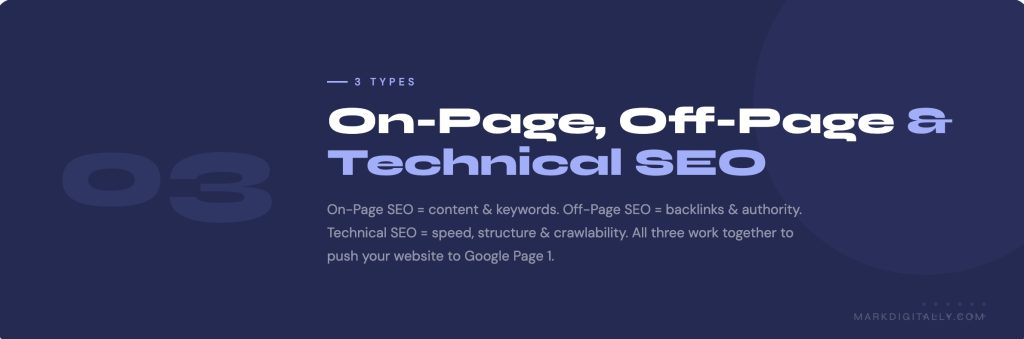
SEO is not just one thing. It has three distinct pillars, and all three must work together for your website to rank consistently on Google.
1. On-Page SEO
On-page SEO refers to everything you optimize directly on your web pages — the content, keywords, headings, meta tags, images, and internal links.
Key on-page SEO elements:
- Title tags and meta descriptions
- Keyword research and keyword placement
- Heading structure (H1, H2, H3)
- Content quality and word count
- Image alt text and compression
- Internal linking between pages
- URL structure and permalinks
On-page SEO is the most direct signal to Google about what your page is about and who it should rank for. It’s also the area where you have the most control — making it the ideal starting point for any SEO strategy.
Want a complete on-page SEO framework? Read our On-Page SEO Checklist: 15 Things to Optimize Before You Publish.
2. Off-Page SEO
Off-page SEO refers to actions taken outside your website that influence your rankings — primarily building backlinks (other websites linking to yours).
When a reputable website links to your page, Google sees it as a vote of confidence — a signal that your content is trustworthy and authoritative. The more high-quality backlinks you earn, the more Google trusts your website.
Key off-page SEO elements:
- Backlink building from authoritative websites
- Guest blogging and content partnerships
- Social media signals and brand mentions
- Local citations and directory listings
- Google My Business optimization
3. Technical SEO
Technical SEO refers to the backend optimizations that help Google crawl and index your site more effectively — and ensure users have a fast, smooth experience.
Key technical SEO elements:
- Page speed and Core Web Vitals
- Mobile-friendliness and responsive design
- XML sitemaps and robots.txt
- HTTPS / SSL security
- Structured data and schema markup
- Fixing broken links and 404 errors
- Canonical tags to avoid duplicate content
SEO vs Google Ads — What’s the Difference?
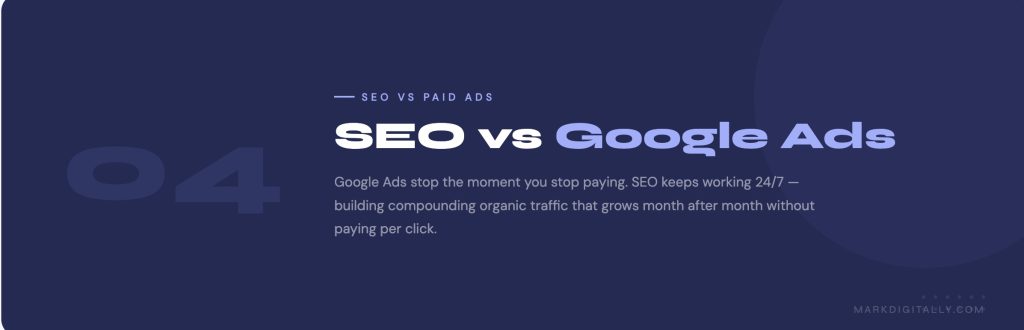
This is one of the most common questions from business owners in India: “Should I do SEO or run Google Ads?”
The honest answer: both have their place — but SEO and Google Ads work very differently.
| Factor | SEO | Google Ads |
|---|---|---|
| Cost per click | Free (organic) | Paid per click |
| Time to results | 3–6 months | Immediate |
| Long-term value | Compounding growth | Stops when budget ends |
| User trust | High (organic listings) | Lower (marked as “Ad”) |
| Best for | Sustainable growth | Immediate lead generation |
| ROI over time | Increases over time | Fixed per campaign |
Our recommendation for Indian businesses: Start with Google Ads if you need immediate leads. But always invest in SEO in parallel — because in 6 months, SEO will start delivering free traffic that Google Ads can never match in cost-efficiency.
Learn more about our Digital Marketing Services in Gurugram — including both SEO and Google Ads management.
How Long Does SEO Take to Show Results?
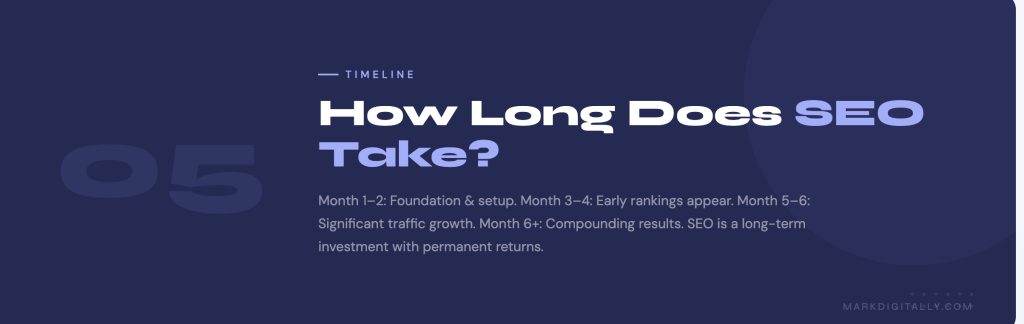
This is the most important question to answer honestly — because SEO is not an overnight solution.
Here’s a realistic SEO timeline for an Indian business starting from scratch:
- Month 1–2: Technical setup, keyword research, on-page optimization, content creation begins
- Month 3–4: Early rankings start appearing for lower-competition keywords, crawling improves
- Month 4–6: Noticeable traffic growth, more keywords ranking, backlink building underway
- Month 6–12: Significant organic traffic, competitive keywords starting to rank on page 1
- Month 12+: Compounding growth — each new piece of content and backlink amplifies results
The best time to start SEO was 6 months ago. The second best time is today. Every day you wait is a day your competitors build more authority on Google.
What is Local SEO? (Essential for Gurugram Businesses)
Local SEO is a specialized branch of SEO that helps businesses rank in local search results — including Google Maps and “near me” searches.
If you run a business in Gurugram — whether it’s a restaurant, clinic, agency, or retail store — local SEO is non-negotiable.
When someone searches “digital marketing agency in Gurugram” or “best restaurant near me,” local SEO determines which businesses appear in those results.
Key local SEO tactics:
- Setting up and optimizing your Google My Business profile
- Building local citations (consistent NAP: Name, Address, Phone)
- Getting Google reviews from real customers
- Creating location-specific content and pages
- Optimizing for “near me” and city-specific keywords
SEO Terminology You Need to Know
Before you start implementing SEO, here are the key terms every beginner must understand:
- Keyword: The word or phrase people type into Google (e.g., “what is SEO”)
- SERP: Search Engine Results Page — the page Google shows after a search
- Organic traffic: Visitors who come to your site from Google without you paying for it
- Backlink: A link from another website pointing to yours — a major ranking signal
- Domain Authority (DA): A score (1–100) indicating how authoritative your website is
- Crawling: Google’s bots scanning your website to discover and read its pages
- Indexing: Google adding your page to its searchable database
- Ranking: Your position in Google’s search results for a specific keyword
- CTR (Click-Through Rate): The percentage of people who click your result after seeing it
- Bounce Rate: The percentage of visitors who leave your site after viewing only one page
- Core Web Vitals: Google’s page experience metrics — loading, interactivity, visual stability
- E-E-A-T: Experience, Expertise, Authoritativeness, Trustworthiness — Google’s content quality framework
How to Start SEO for Your Business — 5 First Steps

If you’re ready to start SEO for your business, here are the five most important first steps:
Step 1: Set Up Google Search Console (Free)
Google Search Console is a free tool that shows you how Google sees your website — which keywords you rank for, which pages are indexed, and any technical errors. This is your SEO command center.
Step 2: Install an SEO Plugin (Rank Math or Yoast)
If your website is on WordPress, install Rank Math SEO — the most powerful free SEO plugin available. It guides you through on-page optimization with a real-time score for every page and post.
Step 3: Do Keyword Research
Find out exactly what your target customers are searching on Google. Use free tools like Google Keyword Planner, Ubersuggest, or Google’s “People Also Ask” section to discover high-value keywords in your niche.
Step 4: Optimize Your Existing Pages
Before creating new content, audit your existing website pages. Optimize your homepage, service pages, and about page with the keywords your customers are searching. This is the fastest way to see early SEO improvements.
Step 5: Start Publishing SEO-Optimized Blog Content
Consistent, high-quality blog content is the engine of long-term SEO success. Each blog post you publish is a new opportunity to rank for additional keywords and attract new visitors to your website.
Conclusion — SEO is the Best Long-Term Investment for Your Business
Now you know exactly what SEO is, how it works, and why it matters for your business in 2026.
SEO is not magic. It’s not instant. But it is the single most powerful, cost-effective digital marketing strategy available to any business — large or small, in Gurugram or anywhere in India.
Every page that ranks on Google is a 24/7 salesperson working for your business without any ongoing cost. Every blog post you publish is a new opportunity to reach a customer who has never heard of you before.
The businesses winning online today started their SEO journey months or years ago. The businesses winning online in 2027 are the ones who start today.
Ready to start your SEO journey? Contact Mark Digitally for a free SEO audit — we’ll show you exactly where your website stands and what it needs to rank on Google Page 1.
Quick Summary — What is SEO?
- SEO = Search Engine Optimization — getting your website to rank higher on Google for free
- 3 types of SEO: On-Page, Off-Page, and Technical SEO
- SEO takes 3–6 months to show results but delivers compounding growth long-term
- SEO is free traffic; Google Ads is paid traffic — both have their place
- Local SEO is essential for businesses serving a specific city or region
- Start with Google Search Console + Rank Math plugin + keyword research
- Consistent blog content is the engine of long-term SEO success
Want to go deeper? Read our complete On-Page SEO Checklist — the exact framework Mark Digitally uses to optimize every page on this website.