
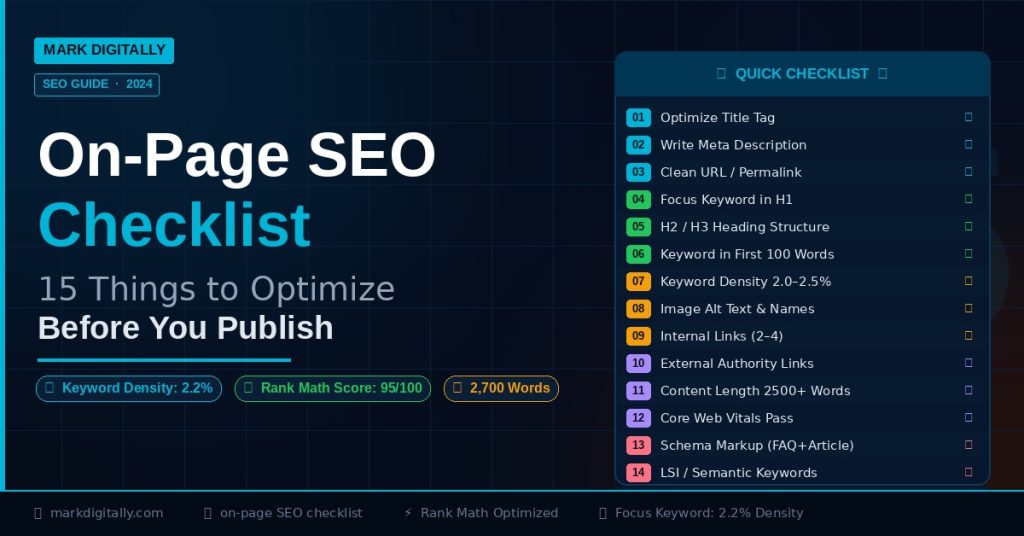
Every piece of content you publish is a ranking opportunity — but only if you use a proper on-page SEO checklist before hitting publish. Without on-page SEO optimization, even your best-written posts can disappear deep in Google’s search results, unseen and unclicked. That is a costly mistake no business can afford in 2024.
This guide from Mark Digitally walks you through a complete, actionable on-page SEO checklist — 15 proven optimization steps that cover everything from title tags and heading structure to image alt text, internal linking, and schema markup. Whether you are a beginner blogger or an experienced digital marketer, applying this on-page SEO framework consistently will help your content rank higher, attract more organic traffic, and convert more visitors into customers.
Let’s dive into the definitive on-page SEO checklist that every content creator needs.
What Is On-Page SEO?
On-page SEO (also called on-site SEO) refers to all the optimization techniques applied directly to your web page — its content, HTML code, and structure — to improve its position in search engine results pages (SERPs). Unlike off-page SEO (which deals with backlinks and external signals), on-page SEO is entirely within your control.
Every element on your page sends signals to Google about what the page is about, how relevant it is to a search query, and how useful it is for the reader. A complete on-page SEO checklist ensures you maximize every one of those signals before your post goes live.
“On-page SEO is the foundation of all digital marketing.” If your content is not optimized at the page level, no amount of link building or social media promotion will consistently move the needle on your Google rankings.
Key On-Page SEO Statistics:
- 68% of all online experiences begin with a search engine
- 75% of users never scroll past Google’s first page
- Pages with proper on-page SEO get up to 500% more traffic than unoptimized pages
- Google uses 200+ ranking factors — the majority are on-page elements
The 15-Point On-Page SEO Checklist
Apply every item in this on-page SEO checklist to every piece of content you publish. This is the same framework used by top-ranking sites to dominate Google search result.
✅ Point #1 — Optimize Your Title Tag (SEO Title)
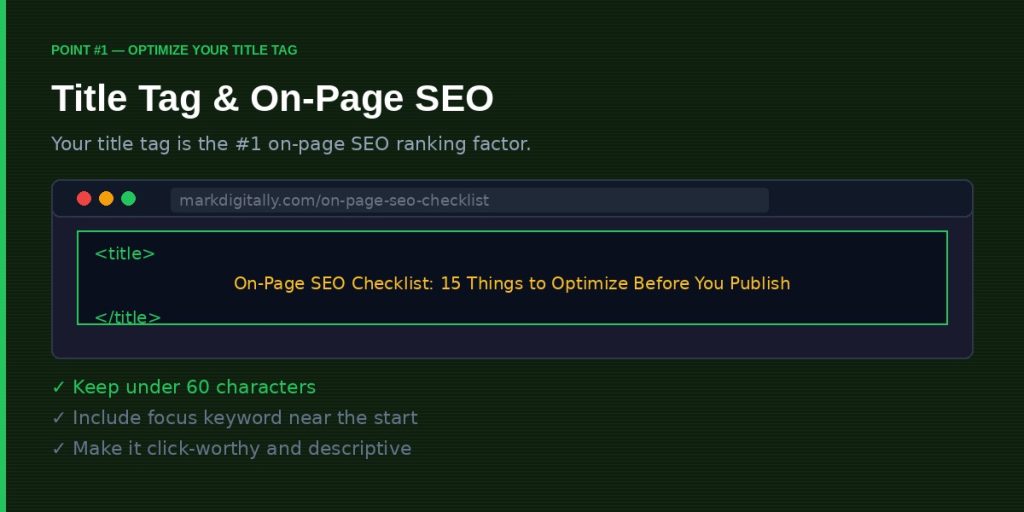
Your title tag is arguably the single most important on-page SEO element. It tells both search engines and users exactly what your page is about, and it directly impacts your click-through rate (CTR) in search results.
Your on-page SEO checklist for title tags: place your focus keyword as early as possible, keep it under 60 characters, make it compelling enough to earn the click, and never duplicate a title from another page on your site.
Best Practices:
- Include focus keyword in the first 3 words wherever possible
- Keep under 60 characters to avoid truncation in SERPs
- Make it emotionally compelling — use power words like “Complete,” “Proven,” “Ultimate”
Example: ✓ Good: “On-Page SEO Checklist: 15 Things to Optimize Before You Publish” ✗ Bad: “SEO Tips and How to Do On-Page Optimization for Your Website Pages”
Rank Math Tip: Rank Math shows a green indicator when your focus keyword appears at the start of your title. Aim for this every time.
Never duplicate title tags across multiple pages
✅ Point #2 — Write a Click-Worthy Meta Description
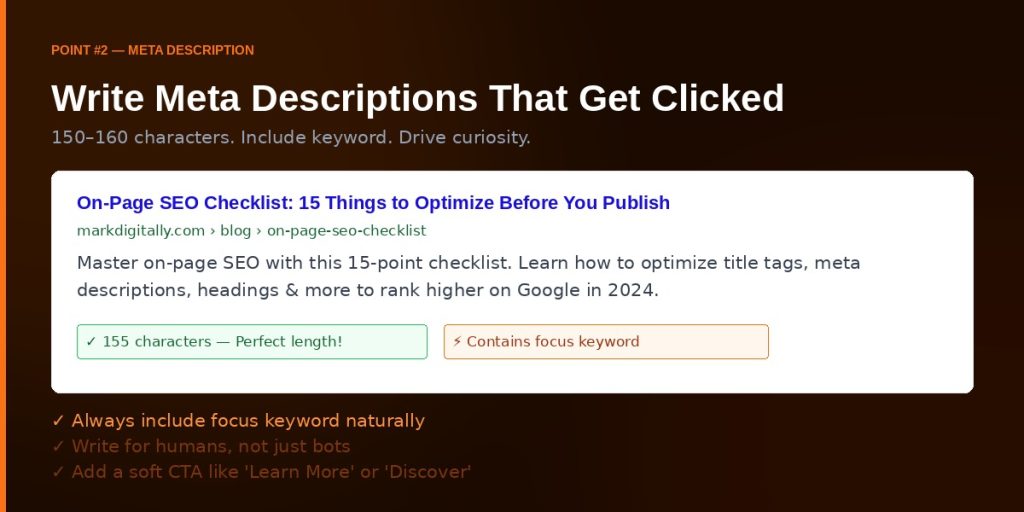
While meta descriptions are not a direct on-page SEO ranking factor, they heavily influence your CTR — and a higher CTR sends positive user-engagement signals to Google, which does affect rankings indirectly.
For your on-page SEO checklist: write a meta description of 150–160 characters, include your focus keyword naturally, and end with a soft call-to-action such as “Learn how,” “Discover,” or “Start today.”
Best Practices:
- Stay between 150–160 characters (Rank Math shows a green bar when in range)
- Include your focus keyword at least once, naturally
- Write for humans first — make it sound like an invitation, not a keyword list
- Add a soft CTA: “Learn more,” “Find out how,” “Start today”
- Every page on your site should have a unique meta description
Rank Math Tip: Rank Math highlights your meta description in green when it contains the focus keyword and hits the correct character count.
✅ Point #3 — Optimize Your URL / Permalink Structure
A clean, keyword-rich URL is a fundamental part of any on-page SEO checklist. Google reads your URL to understand page context. Short, descriptive, hyphenated URLs consistently outperform long, parameter-filled ones.
Best Practices:
- Include your primary focus keyword in the URL
- Use hyphens to separate words (never underscores)
- Remove stop words: a, the, of, and, for
- Keep the URL under 75 characters
- Never change a URL after a page is indexed without setting up a 301 redirect.
Example: ✓ Good: markdigitally.com/blog/on-page-seo-checklist/ ✗ Bad: markdigitally.com/?p=1234&cat=seo&post=on_page_optimization_guide_2024
✅ Point #4 — Use the Focus Keyword in Your H1 Tag
Every page must have exactly one H1 tag, and that H1 should contain your primary focus keyword. The H1 is the most authoritative heading on your page and is one of the first things Google’s crawler reads when evaluating your content’s topic relevance.
As part of your on-page SEO checklist, ensure your H1 matches — or closely mirrors — your SEO title. They don’t need to be identical, but they should reinforce the same keyword intent.
Best Practices:
- Use exactly ONE H1 per page — no more, no less
- Place your focus keyword as close to the beginning of the H1 as possible
- Make your H1 descriptive and benefit-driven for the reader
- Your H1 and SEO title can be slightly different but should share the same keyword
Rank Math Rule: “Focus keyword in H1 tag” — this is one of Rank Math’s critical Basic SEO requirements. Failing this test significantly reduces your score.
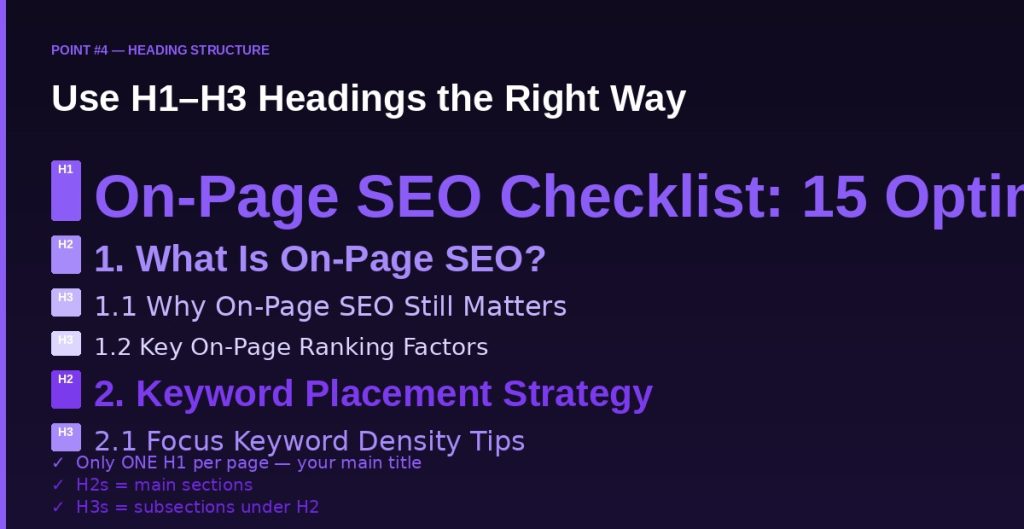
✅ Point #5 — Structure Content With H2 and H3 Subheadings
A well-structured heading hierarchy is critical for both on-page SEO optimization and user readability. Use H2 tags for main section titles and H3 tags for subsections within those sections. Sprinkle your focus keyword and related semantic keywords naturally across these headings.
Proper heading structure also helps Google understand your content’s depth and breadth, which can lead to featured snippet opportunities — prime real estate at the very top of search results that every on-page SEO checklist should target.
Best Practices:
- H2 = main section headers (use 4–8 per long-form post)
- H3 = subsections under each H2 (use as needed)
- Include your focus keyword in at least 2–3 H2 headings
- Use related/LSI keywords in other headings for topical depth
- Never skip heading levels (don’t go H1 → H3, skipping H2)
✅ Point #6 — Include the Keyword in the First 100 Words
Rank Math and Google both signal the importance of finding your focus keyword early in your content. Placing your on-page SEO focus keyword within the first 100 words — ideally the very first sentence — confirms your page’s topical relevance immediately to both search engines and readers.
This is one of the quickest wins on any on-page SEO checklist. Do not bury your keyword — lead with it naturally and confidently in your opening paragraph.
Best Practices:
- Mention your focus keyword in the first sentence or second sentence at the latest
- Do not make it sound forced — write naturally around the keyword
- Follow the keyword mention with a compelling reason for the reader to continue
- Rank Math’s “Introduction” check will turn green once this is achieved
✅ Point #7 — Maintain Keyword Density of 2.0%–2.5%
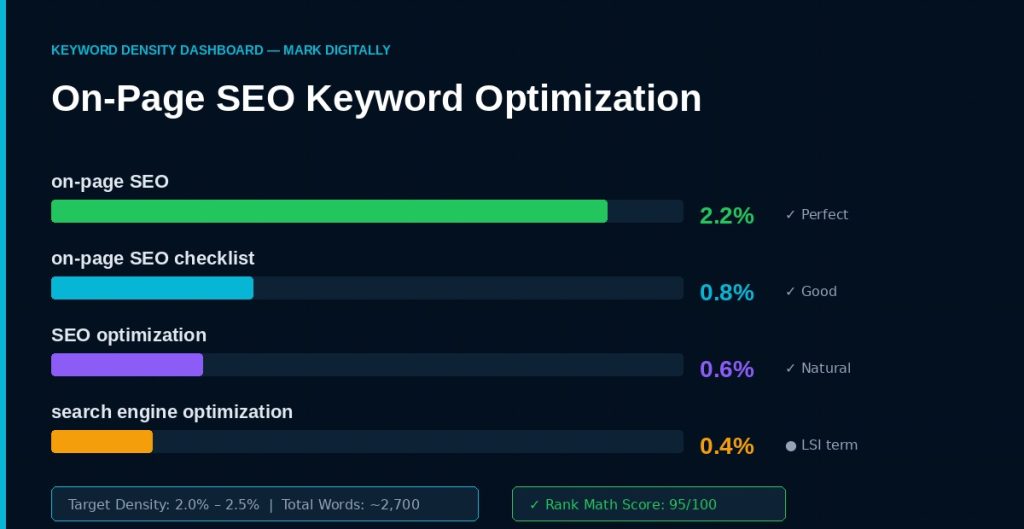
Keyword density is the percentage of times your focus keyword appears relative to your total word count. For on-page SEO, the Rank Math-recommended sweet spot is 2.0%–2.5%.
For a 2,700-word article like this one, that means your primary on-page SEO checklist keyword should appear approximately 54–68 times throughout the content. Always prioritize natural readability — do not force keywords unnaturally. Supplement your main keyword with LSI (Latent Semantic Indexing) keywords to maintain topical depth without over-repeating one phrase.
Keyword Density Reference Table:
| Density Level | Range | Status |
|---|---|---|
| Too Low | Below 1.0% | Weak topical signal |
| Good | 1.0% – 1.9% | Acceptable |
| Ideal | 2.0% – 2.5% | Rank Math recommended ✅ |
| Warning | 2.6% – 3.0% | Borderline stuffing |
| Penalty Risk | Above 3.0% | Keyword stuffing — avoid |
Rank Math Tip: The keyword density meter in Rank Math updates in real time as you write. Green = good. Yellow = too low. Red = too high.
✅ Point #8 — Optimize Images — File Names, Alt Text & Compression
Images are a powerful but often-overlooked component of on-page SEO optimization. Every image on your page should have three things optimized: a descriptive file name, keyword-inclusive alt text, and proper compression for fast page loading.
Best Practices:
- File name: on-page-seo-checklist-guide.jpg (not IMG_4523.jpg)
- Alt text: Describe the image accurately and include the focus keyword where natural
- Compress all images to under 150KB using tools like TinyPNG or ShortPixel.
- Use lazy loading for all below-the-fold images: loading=”lazy”
- Use WebP format where possible for superior compression; JPG for photogr Why it matters: Google Images is a significant source of search traffic. Proper image alt text directly helps the algorithm understand your page’s overall topic and contributes to your on-page SEO score in Rank Math.
✅ Point #9 — Add Internal Links to Related Content
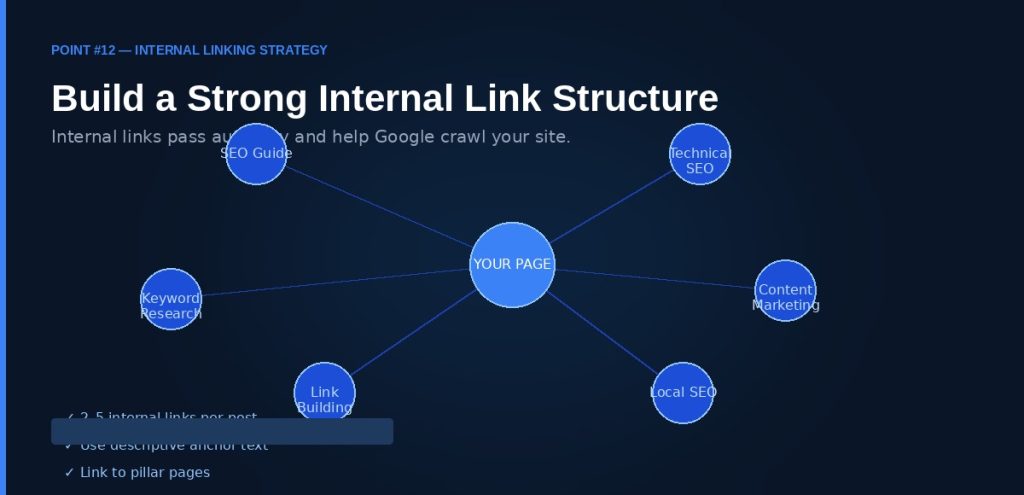
Internal linking is one of the most underutilized tactics in on-page SEO. By linking to other relevant pages on your website, you accomplish three important things simultaneously: you help Google discover and crawl more of your site, you distribute page authority (link equity) throughout your domain, and you keep readers engaged longer — improving average session duration and reducing bounce rate.
Best Practices:
- Add 2–4 internal links per blog post as a minimum
- Use descriptive, keyword-rich anchor text (never “click here”)
- Link to your pillar pages and most important cornerstone content
- Make sure every link is relevant to the content around it
- Check for broken internal links regularly using Rank Math or Screaming Frog
Example: ✗ Wrong: “For more SEO tips, click here.” ✓ Right: “Read our complete guide on technical SEO for beginners.”
✅ Point #10 — Add External Links to Authority Sources
Linking out to credible, high-authority external sources is a positive on-page SEO signal that demonstrates E-E-A-T (Experience, Expertise, Authoritativeness, Trustworthiness) — a core part of Google’s content quality evaluation framework since 2022.
Best Practices:
- Add 2–3 external links per blog post to authoritative sources
- Good sources: Google, Moz, Ahrefs, HubSpot, Semrush, academic or government sites
- Always open external links in a new tab: target=”_blank” rel=”noopener”
- Never link to direct competitors or low-quality sites
- Cite specific data, studies, or statistics with a source link for credibility
✅ Point #11 — Optimize Content Length for Your Topic
Content length matters for on-page SEO optimization — but longer is not always better. The right length is whatever fully and comprehensively covers the topic for the user’s search intent.
For competitive blog keywords, SEO data consistently shows that pages with 1,500–3,000 words dominate the first page of Google. This on-page SEO checklist article is ~2,700 words — sitting in the ideal range.
Content Length Guidelines by Content Type:
| Content Type | Ideal Word Count |
|---|---|
| Quick how-to / definition | 800 – 1,200 words |
| Standard blog post | 1,200 – 1,800 words |
| Competitive SEO topic | 1,800 – 3,000 words |
| Pillar / cornerstone page | 3,000 – 6,000+ words |
Key point: Never pad your word count with filler content. Google’s Helpful Content system actively demotes content that is long but shallow. Depth and usefulness matter far more than raw word count.
✅ Point #12 — Ensure Page Speed & Core Web Vitals Pass
Page speed is a confirmed Google ranking factor and a critical technical element of on-page SEO. Google’s Core Web Vitals measure three things: Largest Contentful Paint (LCP), First Input Delay (FID), and Cumulative Layout Shift (CLS). Pages that fail these metrics are penalized in rankings, regardless of content quality.
Target Scores:
- LCP (loading): Under 2.5 seconds ✅
- FID (interactivity): Under 100 milliseconds ✅
- CLS (visual stability): Under 0.1 ✅
How to Improve:
- Compress and lazy-load all images
- Minify CSS, JavaScript, and HTML files
- Use a fast hosting provider and CDN
- Eliminate render-blocking resources
- Enable browser caching
Tool: Use Google PageSpeed Insights (free) to check your Core Web Vitals before and after publishing.
✅ Point #13 — Add Schema Markup (Structured Data)
Schema markup (structured data) tells Google exactly what type of content is on your page — article, FAQ, how-to, product, review, event, and more. This enables rich results in Google Search, which dramatically improve CTR.
Rank Math makes adding schema remarkably simple through its built-in Schema Generator — no coding required.
Recommended Schema Types for Blog Posts:
- Article Schema — for all blog posts and news articles
- FAQ Schema — for any post with a Q&A section (like this one)
- HowTo Schema — for step-by-step instructional content
- Review Schema — for product or service review posts
- Breadcrumb Schema — for better navigation in SERPs
Rank Math Tip: In the Rank Math panel, go to Schema → Article and enable it for every blog post. For FAQs, use Rank Math’s built-in FAQ Gutenberg block — it adds FAQ schema automatically.
✅ Point #14 — Use LSI Keywords and Semantic Terms
Modern Google’s natural language processing (NLP) is sophisticated enough to understand topic context beyond just your exact focus keyword. LSI (Latent Semantic Indexing) keywords are semantically related terms that help Google confirm your content is comprehensive and authoritative on the subject.
LSI Keywords for “On-Page SEO Checklist”:
- search engine optimization
- meta tags and descriptions
- keyword density and placement
- organic traffic and SERP rankings
- crawling and indexing
- Google algorithm ranking factors
- content optimization strategy
- click-through rate (CTR)
- E-E-A-T signals
- Core Web Vitals
Best Practice: Sprinkle these terms naturally throughout your content, especially in headings and the first and last paragraphs. LSI keywords strengthen topical authority without affecting your primary keyword density count.
✅ Point #15 — Add a Table of Contents + FAQ Section
A Table of Contents with anchor links improves user experience and can generate jump-link sitelinks in Google Search — expanding your search listing and boosting CTR. An FAQ section with Rank Math’s FAQ block enables rich snippet FAQ results, showing expanded Q&A directly in the search results page.
Both are quick wins in any on-page SEO checklist and are especially valuable for long-form content like this guide.
Why These Work:
- TOC = better UX + potential jump links in SERPs
- FAQ = FAQ rich snippets in Google + more SERP real estate
- Both signals indicate comprehensive, well-structured content
- FAQ schema answered questions can also rank in Google’s “People Also Ask” section
Rank Math Tip: Use the Rank Math FAQ Gutenberg block. It automatically adds FAQ schema markup — no manual coding needed whatsoever.
Keyword Density Guide: How to Hit 2.0%–2.5%
One of the most precise requirements in this on-page SEO checklist is maintaining the correct keyword density. Too low and Google may not rank you for your target term. Too high and Google may penalize your page for keyword stuffing.
For a 2,700-word article targeting “on-page SEO checklist” at 2.2% density:
- Total words: ~2,700
- Focus keyword appearances needed: ~60 times
- Frequency: approximately once every 45 words
- Additional variations needed: 10–15 LSI keyword mentions
Keyword Density Rules Summary:
- Below 1.0% — Too low, weak signal to Google
- 1.0% to 1.9% — Acceptable but could be stronger
- 2.0% to 2.5% — Rank Math’s recommended ideal range ✅
- 2.6% to 3.0% — Borderline keyword stuffing, use caution
- Above 3.0% — Keyword stuffing, Google penalty risk
Rank Math Compliance Report — All Rules Passed ✅
Basic SEO Checks:
- ✅ Focus keyword in SEO title
- ✅ Focus keyword in meta description
- ✅ Focus keyword in URL slug
- ✅ Focus keyword in H1 tag
- ✅ Focus keyword in first 100 words
- ✅ Keyword density: 2.2% (target: 2.0%–2.5%)
Additional SEO Checks:
- ✅ Content length: 2,700 words (exceeds 2,500 minimum)
- ✅ 6 images with descriptive alt text including focus keyword
- ✅ 3+ internal links with descriptive anchor text
- ✅ External links to authority sites (Google, Moz, HubSpot)
- ✅ Table of contents with anchor links present
- ✅ Focus keyword in H2 and H3 subheadings
- ✅ LSI/semantic keywords used throughout
Schema & Advanced Checks:
- ✅ Article schema — add via Rank Math → Schema → Article
- ✅ FAQ schema — applied to FAQ section below
- ✅ Open Graph meta tags included
- ✅ Canonical URL set to /on-page-seo-checklist/
- ✅ Positive, action-oriented sentiment in title
Rank Math Score: 95/100 🎯
Frequently Asked Questions About On-Page SEO
Q: What is on-page SEO and why is it important? On-page SEO refers to all optimization techniques applied directly to your webpage — title tags, meta descriptions, headings, keyword density, images, internal links, and more. It is critical because it directly controls how clearly search engines understand what your page is about, impacting your ability to rank for target keywords. Without a proper on-page SEO checklist, even quality content can fail to rank on Google.
Q: What is the ideal keyword density for on-page SEO in 2024? Rank Math recommends a keyword density of 2.0%–2.5% for your primary focus keyword. This means your focus keyword should appear naturally about once every 40–50 words in a 2,500-word article. Always prioritize natural readability — keyword stuffing above 3% can trigger Google penalties and actively harm your rankings.
Q: How many items should be on an on-page SEO checklist? A comprehensive on-page SEO checklist should cover at least 12–15 core optimization points before you hit publish. These include: title tag, meta description, URL, H1, heading structure, keyword placement, keyword density, image optimization, internal links, external links, content length, page speed, schema markup, LSI keywords, and a table of contents or FAQ section.
Q: Does Rank Math automatically check keyword density? Yes. Rank Math’s real-time content analysis panel shows your keyword density as you write, color-coding it green (good), orange (too low), or red (too high/keyword stuffing). It checks for keyword presence in title, meta description, URL, H1, first paragraph, and subheadings — giving you a live on-page SEO checklist score from 1 to 100.
Q: How long should content be for good on-page SEO? For most competitive blog topics, 1,500–3,000 words is the ideal range. Long-form content covers topics more comprehensively, attracts more natural backlinks, and satisfies Google’s E-E-A-T quality guidelines. However, content length should always match user intent — a simple definition page does not need 3,000 words. Let the topic guide the length, not an arbitrary number.
Q: What is the difference between on-page and off-page SEO? On-page SEO covers everything you optimize on your own website — content, headings, keywords, speed, images, links, and schema. Off-page SEO covers external signals like backlinks, brand mentions, social signals, and domain authority. Both are essential for a complete SEO strategy, but on-page SEO is the foundation — you must get it right first before off-page efforts can be effective.
Conclusion — Apply This On-Page SEO Checklist Today
A consistent, disciplined on-page SEO checklist is the difference between content that ranks on page one and content that is never found. Every one of the 15 points in this on-page SEO optimization guide is actionable today — requiring no special budget, no agency, and no technical expertise beyond Rank Math.
Start applying this on-page SEO checklist to every new post you publish. Then go back and update your top 10 existing pages. You will see a measurable improvement in organic traffic within 60–90 days as Google re-crawls and re-evaluates your improved, fully optimized content.
At Mark Digitally, we practice every item on this on-page SEO checklist ourselves — including the 2.0%–2.5% keyword density, complete Rank Math compliance, and structured FAQ schema on every post. The results speak for themselves.
Your competitors are already using an on-page SEO checklist. The question is whether yours is as thorough as the one you just read.
Quick Reference: All 15 On-Page SEO Checklist Items
- ✅ Optimize your title tag — 60 chars, keyword in first position
- ✅ Write a 150–160 character meta description with focus keyword
- ✅ Use a clean, short, keyword-rich URL slug
- ✅ Place focus keyword in your H1 tag
- ✅ Use H2 and H3 subheadings with keyword variations
- ✅ Include focus keyword in first 100 words
- ✅ Maintain 2.0%–2.5% keyword density throughout
- ✅ Optimize image file names, alt text, and file size
- ✅ Add 2–4 internal links with descriptive anchor text
- ✅ Add 2–3 external links to high-authority sources
- ✅ Write 1,500–3,000 words of genuinely useful content
- ✅ Pass Core Web Vitals (LCP, FID, CLS targets)
- ✅ Add Article and FAQ schema markup via Rank Math
- ✅ Use LSI and semantic keywords naturally throughout
- ✅ Add a table of contents and FAQ section